
Summary
Cross-disciplinary learning across data analysis, AI, healthcare, medical research, and clinical context helps turn technical skill into more useful insight. The focus is domain fluency, not clinical authority: understanding what healthcare data means, why it matters, and how to communicate it clearly.
Key Points
- Technical skill alone isn’t enough for healthcare data work.
Analysts also need to understand the clinical, scientific, operational, and ethical context behind the data. - Medical and healthcare-focused courses build domain fluency.
They help explain why certain measures, outcomes, patterns, and risks matter in real-world decision-making. - Data, AI, SQL, visualization, and statistics provide the technical foundation.
These skills support efficient workflows, stronger analysis, and clearer communication of insight. - Clinical reasoning strengthens analytical judgment.
Pattern recognition, ambiguity, hypothesis testing, and decision-making under uncertainty all translate well to data work. - Cross-disciplinary learning makes analysis more useful.
Better healthcare analysis connects technical skill with context, communication, and the people represented by the data.
Healthcare data doesn’t exist in isolation.
As a data analyst, I don’t need to practice medicine. I do need to understand the clinical and operational context behind the data I work with. Medical courses help me see what matters to healthcare professionals, how they use information, and why certain measures, outcomes, and patterns carry real significance.
It’s about building domain fluency, not claiming clinical authority.
That distinction matters. Data can show what happened, where patterns exist, and where something may need attention. But without context, it’s easy to misread what the data means or present it in a way that doesn’t support real-world decision-making.
That’s one reason I’ve taken courses in diabetes, obesity care, continuous glucose monitoring, epidemiology, medical research, GLP-1 therapies, drug development, and related areas. They make me a more informed analyst, writer, and communicator.
The learning curve is steeper for me than it would be for someone with clinical training. I often need to re-read material, revisit sections of video, and ask questions until the concepts land. That effort is part of the value because it forces me to slow down and understand the context more carefully.
They help me ask better questions.
They help me understand why certain outcomes matter.
They help me recognize when a number needs context before it becomes useful.
They also help me communicate more clearly with people who approach the same data from different perspectives.
In healthcare, the same dataset can matter to different people for different reasons. A clinician may focus on treatment decisions. An operations team may focus on workflow. A patient may focus on whether the information feels useful, understandable, and actionable. A data analyst needs to respect those different views.
That’s especially true in my work with diabetes and obesity care. These are areas where data can become personal very quickly. Blood glucose values, Time in Range, weight, medication outcomes, cardiovascular risk, and treatment patterns are not just abstract measures. They reflect people’s daily lives, health concerns, and care decisions.
Understanding that context changes how I approach analysis and visualization.
For example, my work with continuous glucose monitor data isn’t only about creating charts. It’s about finding better ways to show patterns that a single daily number can hide. A daily Time in Range value may look discouraging, but hourly views can show that most of the day went well and that only a few specific periods need attention. That kind of detail can make the information more useful and less judgmental.
Medical and healthcare-focused courses have also improved how I evaluate research and health-related claims. Courses on medical research, epidemiology, and public health strengthened how I think about evidence, bias, study design, population trends, and the limits of what data can prove. That matters whether I’m reviewing clinical literature, writing about a new therapy, or interpreting broader healthcare trends.
The same applies to courses on GLP-1 receptor agonists, obesity management, and diabetes care. These topics appear often in public discussion, but the conversation can become oversimplified. Learning more about the clinical context helps me write about these areas with more care and precision.
The goal isn’t to replace clinical expertise. It’s to better understand the world the data represents.
That broader understanding also supports my work beyond public writing. In any organization, data analysis becomes more valuable when it connects technical skill with practical decision-making. Knowing how stakeholders use information helps me structure analysis, explain findings, and design outputs that people can actually use.
That’s where domain fluency matters.
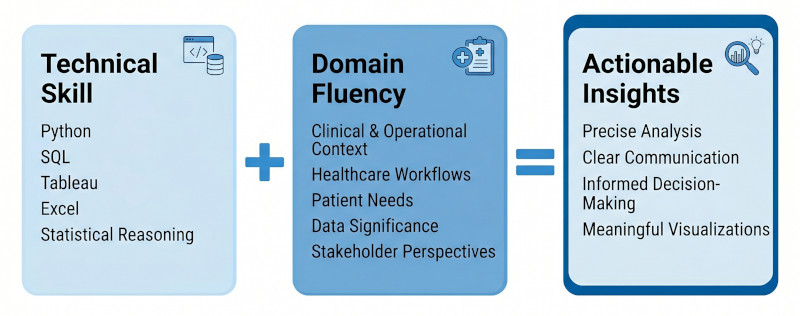
Technical skills are essential. Python, SQL, Tableau, Excel, and statistical reasoning all matter. But in healthcare and related fields, technical skill alone isn’t enough. The analyst also needs to understand the environment around the data: the workflows, constraints, definitions, risks, and decisions behind it.
That’s why I continue to take courses outside a traditional data curriculum.
They make my analysis stronger.
They make my writing clearer.
They help me connect data, healthcare, and communication in a more practical way.
Behind every data point is a person, a process, a decision, or a problem someone is trying to solve. Understanding that context doesn’t make the work less analytical. It makes the analysis more useful.
And that’s the point.
Technical skill helps you work with the data. Domain fluency helps you understand what the data means.
That’s why I continue to learn across disciplines: not to step outside my role, but to do the work inside it with more context, care, and precision.